
A swim camp Antibes trip lets your swimmers train in a heated 50-metre pool in the heart of the French Riviera. Antibes sits between Cannes and Nice, and it has kept the cosy atmosphere and medieval charm of the fishing village it once was.
Below you will find everything coaches need to know about the town, the hotel, the pool and how to plan the week.
Swim camp Antibes at a Glance
Here are the key facts for a swim camp Antibes trip, so you can compare it quickly with other training camps:
- Accommodation: 3-star hotel
- Training: 50 metre outdoor pool
- Meals: Full board
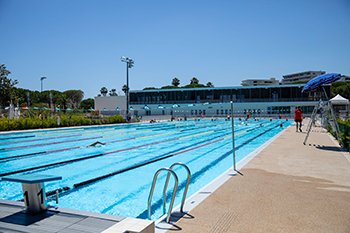
- Training: Training takes place at the incredible Stade Nautique Muncipal in the centre of Antibes. The pool is a 50 metre heated pool with 8 lanes. There is also a 25 metre indoor track available if required.
- Price: on request, depending on dates, group size and room types
Why a Swim Camp in Antibes?
Antibes offers something different from the big beach resorts. It has a marina, a historic ring wall and an old town with many charming small streets. It is known as the city of roses in France, and the Picasso Museum and the Provençal market are both worth a visit during the camp.
The neighbouring town of Juan-les-Pins adds a more modern coastal feel. Flights to Nice are usually well connected with the Nordic capitals, including Stockholm, Copenhagen, Gothenburg and Oslo, which keeps travel simple for Scandinavian clubs.
Hotel Le Collier: Family-Run and Close to the Pool
Accommodation is at Hotel Le Collier, a family-run three-star hotel of a high standard. The Jean Bunoz swimming pool is only about 400 metres away, the harbour is a few minutes’ walk and the old town is about 1.5 kilometres from the hotel.
The hotel is decorated in a traditional style and has 45 rooms with bath or shower, toilet, hairdryer, air conditioning, telephone, TV, kettle and refrigerator. Free Wi-Fi is available. Note that there are only single and double rooms, with no triples or quads, which matters when planning room lists.
There is a cosy Italian restaurant and pizzeria open every evening, and on warmer days the terrace is open too. Full board keeps the routine simple.

Training at Stade Nautique Municipal
The main training venue is the impressive Stade Nautique Municipal in the centre of Antibes. The pool is a heated 50-metre pool with eight lanes, which is perfect for long-course sets, pace work and race rehearsal.
A 25-metre indoor pool is also available if required. This gives the coach a back-up option and the possibility to run short-course sessions, for example for turns and underwater work.
Culture Between Sessions
Antibes is an ideal place for a light-day outing. Walk through the old town, visit the market or take the group to the harbour. These short excursions give swimmers new energy without taking anything away from the training block.
Keep evenings calm and protect sleep: the quality of the morning session depends on it.
Making the Most of Long-Course Training
For many clubs in northern Europe, the biggest benefit of a swim camp abroad is simply time in a 50-metre pool. Long-course water changes the rhythm of a set: fewer turns, more strokes per length and a much clearer picture of each swimmer’s pacing.
Use the camp to test pace over 50s, 100s and 200s, to film strokes from the deck, and to rehearse starts and finishes in race conditions. Swimmers who usually train short course often discover where their stroke breaks down in the second half of a length, which gives clear targets for the season.
Mix this with technique blocks and relay practice, and the camp becomes both a fitness boost and a learning experience.
How to Structure a Week at a Swim Camp
Most clubs get the best results from a camp when the week follows a clear rhythm rather than simply stacking up kilometres. A common pattern is two water sessions a day on the first three days, a lighter half-day in the middle of the week, and then another block of quality work before travel home.
- Day 1: an easy aerobic session after travel, focused on feel for the water and long-course turns.
- Days 2-3: a morning endurance set and an afternoon technique or kick session, plus short dryland work.
- Day 4: one session only, followed by team time, recovery and a group activity.
- Days 5-6: race-pace sets, starts and relays while swimmers are adapted to the pool.
- Final day: a short, sharp swim and a coach debrief before departure.
Keep a shared training log so that every swimmer can see their volume and the coach can adjust the load if fatigue builds up.

Setting Goals for Your Swim Camp
The clubs that get the most out of a training camp decide in advance what the week is for. Is it an aerobic base block early in the season, a technique camp for younger groups, or a sharpening week before a championship? The answer changes how every session is written.
Ask each swimmer to set one personal goal for the week, such as holding a stroke count over 50 metres, improving a turn or completing a key set. Write the goals down and review them on the last evening.
Clear goals also help parents understand why the programme looks the way it does, and they give younger swimmers a sense of progress that lasts long after the trip.
Recovery, Food and Sleep During Training Camps
Double sessions in a 50-metre pool are demanding, and the gains from a swim camp come only when swimmers recover between workouts. Full board makes this much easier, because the group eats at set times and nobody has to search for food after training.
Encourage swimmers to eat a real breakfast before the morning session, refuel within an hour after each swim, and drink water throughout the day, especially in warm climates. A short nap or quiet rest after lunch is worth more than an afternoon on the beach in full sun.
Sleep is the most underrated part of any training camp. Agree on a lights-out time, keep evening activities short, and plan the lighter day of the week so that the group can catch up on rest without losing momentum.
Dryland Ideas That Need Little Equipment
Not every destination has a big gym, and you do not need one for useful dryland work. Short, focused sessions before or after the water keep swimmers strong and reduce the risk of shoulder problems.
- Activation with resistance bands before every swim: external rotations, pull-aparts and scapular work.
- Core circuits: planks, side planks, dead bugs and hollow holds.
- Mobility for thoracic spine, hips and ankles after the afternoon session.
- Light jumping and skipping for younger groups to build coordination.
Keep dryland to 20-30 minutes so it supports, rather than competes with, the water training.
More Training Camps and Sports Camps
If you are comparing destinations, take a look at our overview of swim camps in Europe. Clubs that travel with several teams can also explore our football camps and other sports camps. Related guides:
- Swim Camp Sibenik: 50m Sea-View Pool in Croatia
- Swim Camp Split: Seaside 50m Pool and Hostel Jadran
- Swim Camp Falkenberg: Sweden’s Only 50m Saltwater Pool
Swim camp Antibes: Frequently Asked Questions
How many lanes does the pool in Antibes have?
The heated 50-metre pool at Stade Nautique Municipal has eight lanes.
How far is the hotel from the pool?
Hotel Le Collier is about 400 metres from the Jean Bunoz swimming pool.
Are there triple rooms at the hotel?
No. Hotel Le Collier has only single and double rooms.
Which airport is closest?
Nice airport is the natural gateway to Antibes.
Final Thoughts
A swim camp Antibes week gives your group the right mix of quality facilities, full board and a destination that athletes remember. Request a tailored offer with your dates and group size, and start planning a training camp that moves the whole club forward.